In this guide
- Car Breakdown I-10 Beaumont: The First Five Minutes
- Should You Stay in the Car or Get Out on I-10?
- What Should You Tell the Tow Truck Dispatcher?
- Which Parts of I-10 Around Beaumont Need Extra Care Right Now?
- What Not to Do When You’re Stranded on I-10
- Who Should You Call: 911, *DPS, or a Tow Truck?
- What Happens When the Tow Truck Arrives on I-10?
- I-10 Breakdown FAQs
- Stranded on I-10? Call a Local Crew
- About Hawk Towing & Auto
If your car breaks down on I-10 in Beaumont, get it as far off the lanes as you can, turn on your flashers, and decide whether staying in the car or getting out and away is safer. Then call for help and give the dispatcher your direction of travel, last exit, and which side of the road you’re on.
Last updated: November 14, 2026
I-10 is busy through Jefferson County, with fast traffic, big trucks, and long stretches of work zones. If your car broke down on a highway in Texas, feeling scared is normal. This car breakdown I-10 Beaumont checklist is the one we’d hand a neighbor. It’s written by the local tow crew at Hawk Towing & Auto, and the safety steps come from Texas DPS and TxDOT, not guesswork.
Car Breakdown I-10 Beaumont: The First Five Minutes
The first few minutes matter most. Your goal is simple: get out of the way of traffic and make your car easy to see. Follow these steps in order.
- Get off the pavement if you can. The Texas Driver Handbook says to move your car off the pavement to the side of the road. A flat or blowout can be driven slowly off the road.
- Pick the right shoulder. If you have a choice, aim for the right-hand shoulder or the next exit ramp. Coasting to a frontage road is even better if the car will make it.
- Turn on your flashers. The Texas DPS travel tips say to make your vehicle visible by turning on your flashers.
- At night, light up the inside. The handbook says to turn on your inside lights at night, in addition to your taillights and warning lights.
- Signal that you need help. Tie a white cloth to your antenna or door handle. No cloth? The handbook says raise your hood. Only do this if you can stay well clear of traffic.
- Decide: stay or go. Use the table in the next section.
- Call. 911 for injuries, fire, or danger. A tow truck or the state stranded motorist line for everything else.
Stuck on I-10 right now? Call Hawk Towing & Auto at (409) 790-1677. A local dispatcher picks up 24/7.
Should You Stay in the Car or Get Out on I-10?
If your car is fully off the road, staying inside with the doors locked is usually the safer choice. Texas DPS says to stay with the vehicle if possible, especially at night or in bad weather. If the car is stuck in a lane, smoking, or in deep water, get everyone out and away from it.
These two pieces of state advice fit together. DPS says stay with the car when you can. The Texas Driver Handbook says that if you can’t get the car off the road, get everyone out of the car and off the road. Here’s how that plays out on I-10.
| Your situation | Safer choice | Why |
|---|---|---|
| Car is fully off the pavement on a wide shoulder or ramp | Stay inside, doors locked, flashers on | DPS: stay with the vehicle if possible, especially at night or in bad weather |
| Car stopped in a travel lane and won’t move | Everyone out and off the road | Driver Handbook: if you can’t get the car off the road, get everyone out and off the road |
| Smoke, fire, or a fuel smell | Get out, move well away, call 911 | TxDOT lists 911 for life-threatening roadside emergencies |
| Car stalled in deep water | Get out and move to higher ground if you can do it safely | Driver Handbook and TxDOT flood guidance |
| A stranger stops to help | Stay in, doors locked, window cracked | DPS: ask them to call law enforcement for you |
If you do get out, go away from the traffic side, and never stand between your car and passing traffic. Keep kids and pets with you and well back from the road.
What Should You Tell the Tow Truck Dispatcher?
Tell the dispatcher four things: which direction you were headed on I-10, the last exit or cross street you passed, which side of the highway you’re on, and if you’re on the main lanes, a ramp, or a frontage road. Then add the vehicle, the problem, and your callback number.
A tow truck I-10 Beaumont drivers can count on still has to find you. “I’m on I-10” isn’t enough. Traffic runs two ways, there are main lanes and frontage roads, and the far side of the median can be a long loop away. Use this script.
- Direction: “I’m on I-10 eastbound” (toward Orange County) or “westbound” (toward Chambers County and Houston).
- Last exit or landmark: “I passed the Walden Road exit about a mile ago.” A green exit sign, overpass name, or bridge counts.
- Side: “I’m on the right shoulder” or “I’m on the inside shoulder, next to the median.”
- Road level: “Main lanes,” “exit ramp,” or “frontage road.”
- Vehicle: Year, make, model, color. Say if it’s AWD, lowered, a motorcycle, or a box truck.
- Problem: “Won’t start,” “flat tire,” “overheated,” “keys locked inside,” or “minor crash, no injuries.”
- Safety status: “We’re inside with flashers on” or “We’re out and off the road.”
- Your number: So the driver can call if they can’t spot you.
Sample call: “I’m on I-10 westbound, just past the Walden Road exit, on the right shoulder of the main lanes. It’s a silver 2015 sedan that died and won’t restart. Two of us are inside with flashers on. My cell is the number I’m calling from.”
How do I find my location if I don’t see a mile marker?
Open the map app on your phone and read the pin location or nearest cross street to the dispatcher. If that fails, use the last exit number you saw. On Texas interstates, exit numbers line up with mileposts, so an exit number is a real location clue. Overpass signs and bridge names work too.
TxDOT’s Texas Road Tips handbook labels interstate exits as “exit mileposts.” You don’t need the exact number. “Between exit X and the next overpass” gets a truck very close.
Which Parts of I-10 Around Beaumont Need Extra Care Right Now?
Several long stretches of I-10 in Jefferson County are active work zones, according to TxDOT’s Beaumont District project updates. Shoulders can be narrow, shifted, or gone. On the I-10 bridges over Hillebrandt Bayou, TxDOT lists removal of the inside shoulders. If you start to have car trouble, try to clear the work zone before you stop.
This is the part most breakdown guides skip. Here’s what TxDOT listed for the week of November 9, 2026:
| I-10 project (Jefferson County) | Limits | What it means if you break down |
|---|---|---|
| Eastex Interchange (northern I-10 / US 69 interchange) | Hollywood Overpass to 7th Street | Crews removing eastbound concrete pavement. Expect tight space and stopped traffic. |
| Cardinal Interchange (southern I-10 / US 69 interchange) | Walden Road to US 90 | Inside shoulders being removed on the Hillebrandt Bayou bridges. Don’t plan on stopping next to the median there. |
| I-10 widening | Just west of Hamshire Road to FM 365 | Grading work. Expect construction traffic. |
| I-10 widening | FM 365 to Walden Road | Paving and median drainage work in the median. |
TxDOT lists completion for the widening jobs in spring 2028 and the two interchanges in spring 2031, so these zones will be around a while. Check DriveTexas.org, which TxDOT points to for closures and construction, before a long drive. For more local road tips, see our emergency towing guide for Beaumont.
Broke down in a work zone? Stay put if you’re clear of the lanes and call (409) 790-1677. Tell us the project area or nearest overpass.
What Not to Do When You’re Stranded on I-10
Don’t walk across the lanes, don’t stand behind or beside your car on the traffic side, and don’t try a repair next to moving traffic. Don’t stay with a car stalled in deep water. And don’t stop in a spot with no shoulder if you can safely roll to a ramp or wider spot.
- Don’t cross I-10 on foot. If you’re on the inside shoulder, stay on your side and wait for help.
- Don’t stand between your car and traffic. Not to wave, not to look under the hood.
- Don’t work on the car beside live lanes. Changing a tire inches from 70 mph traffic isn’t worth it.
- Don’t slam the brakes if you drift off the pavement. The handbook says slow down first, check traffic behind you, then ease back on.
- Don’t leave a minor crash blocking traffic. TxDOT says Texas law requires you to move a crashed car out of the flow of traffic if you can, and you don’t need to wait for police to move it.
- Don’t open your door to strangers. DPS advises keeping doors locked, cracking the window, and asking them to call law enforcement.
Who Should You Call: 911, *DPS, or a Tow Truck?
Call 911 for injuries, fire, a crash blocking lanes, or any immediate danger. For non-emergency help, the state stranded motorist line is *DPS (*377) on a cell phone or 1-800-525-5555. If you already know you need a tow or roadside fix, call a local towing company directly.
| Call | When |
|---|---|
| 911 | Injuries, fire, a car stuck in a lane, a crash, or you feel unsafe |
| *DPS (*377) or 1-800-525-5555 | Non-emergency stranded motorist help, answered 24 hours a day by a live operator (TxDOT) |
| Hawk Towing & Auto, (409) 790-1677 | Tow, jump start, flat tire, or lockout, 24/7 |
Sometimes you don’t need a tow at all. A dead battery may just need a jump start service, and a flat on a safe shoulder may only need roadside flat tire help. Tell the dispatcher what happened and they’ll help you sort out which you need.
What Happens When the Tow Truck Arrives on I-10?
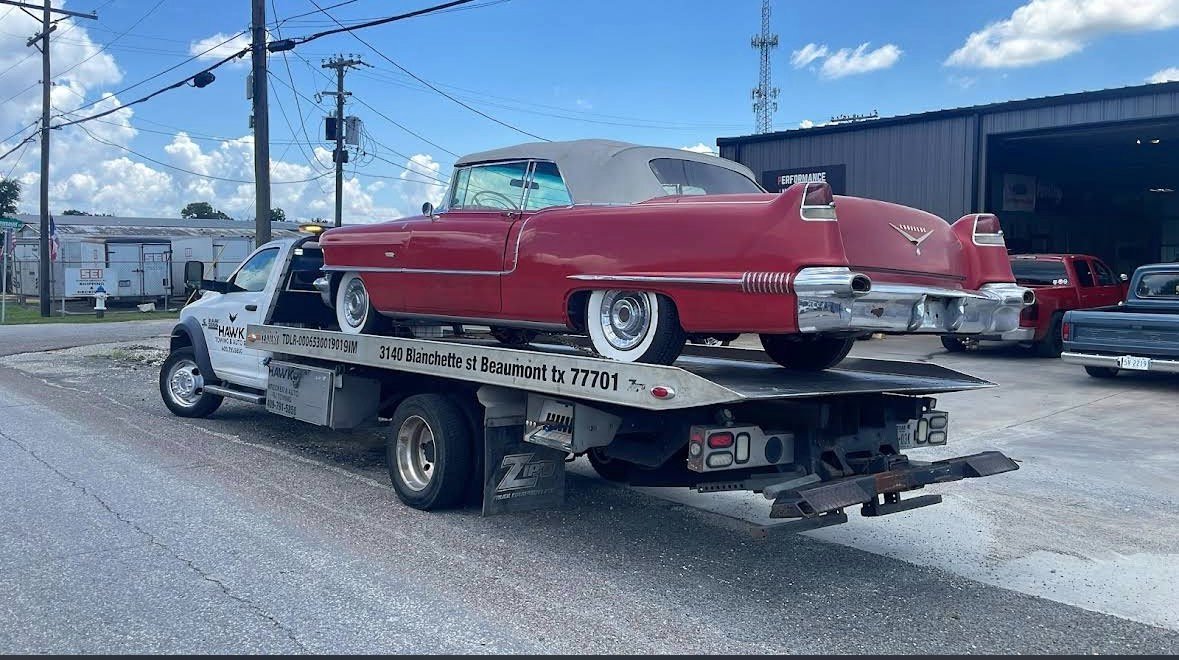
The operator parks behind or ahead of your car with lights on, checks that you’re safe, and then loads your vehicle by flatbed or wheel-lift. Texas law requires passing drivers to move over a lane or slow to 20 mph below the limit for a stopped tow truck using its lights. Stay where the operator tells you.
That rule is Texas Transportation Code Section 545.157, and it covers stopped tow trucks, emergency vehicles, and TxDOT vehicles using their lights. Not every driver follows it, so the crew works from the side away from traffic whenever they can.
The truck depends on your vehicle:
- Flatbed: The bed tilts down and the car is winched on, so all four wheels ride off the ground. This suits AWD cars, lowered cars, and cars that won’t roll. See our flatbed towing in Beaumont.
- Wheel-lift: The truck lifts one end of the car by its wheels. It’s quick for many everyday cars. Learn more about light-duty towing for cars and SUVs.
- Work vans and box trucks: Larger vehicles need bigger equipment. Ask about medium-duty towing for vans and box trucks when you call.
Before the car moves, tell the operator where it’s going: your home, a shop of your choice, or somewhere you name. We also cover towing in Rose City, TX and the rest of Jefferson, Hardin and Orange Counties.
I-10 Breakdown FAQs
Is it safe to change a flat tire on the I-10 shoulder?
We don’t advise it. The Texas Driver Handbook says a car with a flat can be driven slowly off the road, so roll to an exit, ramp or lot if you can. Don’t work on the car next to traffic. Stay safe, call for a tow or flat tire help, and wait.
What is *DPS and when should I use it?
*DPS (*377 on a cell phone) and 1-800-525-5555 reach the Texas stranded motorist line, which TxDOT says is answered 24 hours a day by a live operator. Use it for non-emergency help when you’re stuck. For a crash with injuries, fire, or immediate danger, call 911 instead.
What does the Texas Move Over law require when a tow truck is on the shoulder?
Texas Transportation Code Section 545.157 covers stopped tow trucks using their lights. Drivers must move out of the lane closest to the truck when there are two or more lanes going their way, or slow to 20 mph under the posted limit. If the limit is under 25 mph, they must slow to 5 mph.
What should I do if my car stalls in high water on I-10?
Get out quickly and move to higher ground, as long as you can do it safely. Both the Texas Driver Handbook and TxDOT say this. Don’t stay with a car in deep water, and don’t try to restart it. Call 911 if you’re in danger, then call a tow once you’re safe.
How long will it take a tow truck to reach me on I-10?
It depends on where you are, which direction you’re headed, traffic, weather, and work zones. We don’t guess on a blog. When you call Hawk Towing & Auto, our dispatcher looks at your exact location and gives you an ETA on the phone. A clear location from you helps the truck find you.
Can the tow truck take my car to my own mechanic?
Yes, shop drop-off and home delivery are part of what we do. Tell the dispatcher the shop’s name and address when you call, and check that the shop is open or has a drop box. If you aren’t sure where to go yet, say so and we’ll talk through options.
Stranded on I-10? Call a Local Crew
Being stranded on I-10 is stressful, but a plan helps. Get off the lanes, make the car visible, choose stay or go, and give a clear location. Hawk Towing & Auto is a locally owned towing and roadside assistance company in Beaumont, TX, and we answer the phone 24/7 for drivers across Jefferson, Hardin and Orange Counties.
Need a tow now? Call (409) 790-1677 and tell us your direction, last exit, and which side you’re on.
About Hawk Towing & Auto
Hawk Towing & Auto is a towing and roadside assistance company based in Beaumont, Texas. We tow cars, SUVs and motorcycles with light-duty, medium-duty and flatbed equipment. We also handle jump starts, flat tires and lockouts, and we buy junk cars. Our work covers Jefferson, Hardin and Orange Counties, and you can reach us 24 hours a day, 7 days a week.
Read more about Hawk Towing & Auto or see our full list of towing and roadside services.
Hawk Towing & Auto
3140 Blanchette St, Beaumont, TX 77701
Phone: (409) 790-1677
Open 24 hours, 7 days a week