In this guide
- Accident Towing in Beaumont, TX vs Breakdown Towing: Side by Side
- What Is Accident Towing?
- Who Decides Which Tow Truck Comes After a Crash in Texas?
- What to Do at the Scene Before You Call a Tow
- Do You Need a Flatbed After an Accident?
- When Accident Towing Means Recovery First
- What to Tell the Dispatcher After a Crash
- Insurance Tow After an Accident: What to Ask Your Insurer
- Where Does Your Car Go After an Accident Tow?
- Frequently Asked Questions
- About Hawk Towing & Auto
Accident towing is a tow after a crash. Breakdown towing is a tow for a car that quit on its own. With accident towing in Beaumont, TX, police may be on scene, the car may be bent or leaking, and an officer may start the tow instead of you. After a breakdown, you usually make the call and pick where the car goes.
Last updated: November 19, 2026
We’re Hawk Towing & Auto, a locally owned towing and roadside assistance company in Beaumont, TX. We tow around the clock across Jefferson, Hardin and Orange Counties. This guide covers what really changes when the tow follows a crash, so you know what to expect on I-10, US-69, US-96 or a side street. For the big picture on staying safe while you wait, see our Beaumont emergency towing guide.
Accident Towing in Beaumont, TX vs Breakdown Towing: Side by Side
A breakdown tow and a post-accident tow truck may look the same from the road. The job is not. Here is how the two compare on the things that matter to you.
| What changes | Accident towing | Breakdown towing |
|---|---|---|
| Scene safety | Broken parts, fluids on the road, other drivers, sometimes injuries. Police may be there. | Usually one car on a shoulder, lot or driveway. Passing traffic is the main risk. |
| Who starts the tow | You, or a peace officer. A tow started by an officer is a nonconsent tow. | Almost always you, or the person in control of the car. |
| Vehicle condition | Bent wheels, broken suspension, leaks, airbags out. It may not roll or steer. | Usually intact. Think dead battery, engine or transmission trouble, or a flat. |
| Flatbed need | Often the safer pick when a wheel, axle or steering part is damaged. | Depends on the car and drivetrain. A wheel-lift works for many cars. |
| Recovery and winching | The car may need to be pulled out of a ditch or median before it can be loaded. | Rare. The car is usually on flat, solid ground. |
| Documentation | An officer may file a crash report. Nonconsent tows require a tow ticket. Your photos matter. | Usually just the tow company’s receipt. |
| Insurance involvement | Often part of a claim. Your insurer may care where the car goes. | Maybe roadside coverage, if your policy or plan has it. |
| Where the car goes | Body shop, home, a storage facility, or a buyer if it’s not worth fixing. | Your mechanic, a dealer or home. |
| Time pressure | Lanes need to be cleared. Decisions happen fast. | You can usually take a minute to decide. |
What Is Accident Towing?
Accident towing is moving a car from a crash scene to a safe place, like a body shop, your home or a storage facility. It often includes work a normal tow doesn’t: clearing loose parts, handling a wheel that won’t turn, or winching a car out of a ditch before it can be loaded onto the truck.
Breakdown towing is simpler. The car is whole. It just won’t run. The driver picks the tow company, picks the shop, and the truck loads a car that rolls and steers. Most of the stress comes from waiting on the shoulder, which we cover in our guide to a car breakdown on I-10 in Beaumont.
Collision towing in Texas adds three things a breakdown doesn’t have: a possible police role, a damaged vehicle, and an insurance claim. The rest of this guide takes those one at a time.
Been in a wreck and need a tow you can call yourself? Call Hawk Towing & Auto at (409) 790-1677.
Who Decides Which Tow Truck Comes After a Crash in Texas?
It depends on who starts the tow. Texas towing rules call a tow a consent tow when the owner or driver summons the truck, so you pick the company. A tow started by a peace officer is a nonconsent tow. At a crash, follow the officer’s directions. If the officer is fine with you calling your own tow, the choice is yours.
Here is what the state’s towing regulator, the Texas Department of Licensing and Regulation (TDLR), says on its tow truck permit page:
- Consent tow: any tow where the tow truck is summoned by the owner or operator of the vehicle, or a person who has custody or control of it.
- Nonconsent tow started by a peace officer: this needs a tow truck with an incident management permit.
- Tows from a public road: TDLR says any tow from a public roadway, for any reason, is an incident management tow. So the truck that pulls your car off a highway or city street after a crash needs that permit, no matter who called it.
TDLR also clears up a common mix-up on its tow ticket myths page. Signing a tow ticket at an accident scene does not turn a nonconsent tow into a consent tow. And the owner may only sign for tow-related charges, not repairs. So if anyone at the scene hands you a form, read it before you sign. If it says anything about repairs, you don’t have to sign that.
If your car was towed as a nonconsent tow, TDLR’s consumer information page says the towing company must give you a copy of the tow ticket if you’re present, with each charge itemized. It also says nonconsent tow and storage fees are capped by state law, and cities can set lower limits.
What to Do at the Scene Before You Call a Tow
Safety comes before the tow. These steps come from TxDOT’s collision guidance and DPS travel tips.
- Check for injuries. If anyone is hurt, call 911. TxDOT says to render aid and notify law enforcement.
- Move the car if you can drive it and no one is hurt. TxDOT says that if you can drive the vehicle, the law requires you to move it out of the flow of traffic. You don’t need to wait for police first.
- If it can’t move, make it visible. Turn on your flashers. TxDOT says to protect the scene with flares or by raising your hood.
- Stay away from traffic. DPS advises getting out on the passenger side, away from traffic. Never stand between your car and passing cars.
- Know when to call police. TxDOT lists these cases: someone is hurt or killed, the cars can’t be moved, a driver may be drunk, a driver has no insurance, or a driver leaves the scene.
- Swap information. Share contact, vehicle and insurance details with the other driver.
- Take photos from a safe spot. Get both cars, the plates and the scene. Don’t step into a lane to get a shot.
- Then call for the tow, unless an officer has already called one.
Once the tow truck shows up with its lights on, Texas law protects that crew too. TxDOT’s Move Over or Slow Down page says drivers must move over a lane or slow to 20 mph below the posted limit for tow trucks and other listed vehicles with lights on.
Do You Need a Flatbed After an Accident?
Often, yes. A flatbed carries the whole car off the ground, so damaged wheels, axles and steering don’t have to roll. It’s the safer choice when a car won’t roll straight, has front or rear damage near the wheels, or is all-wheel drive. A wheel-lift can still work for a car with light body damage that rolls fine.
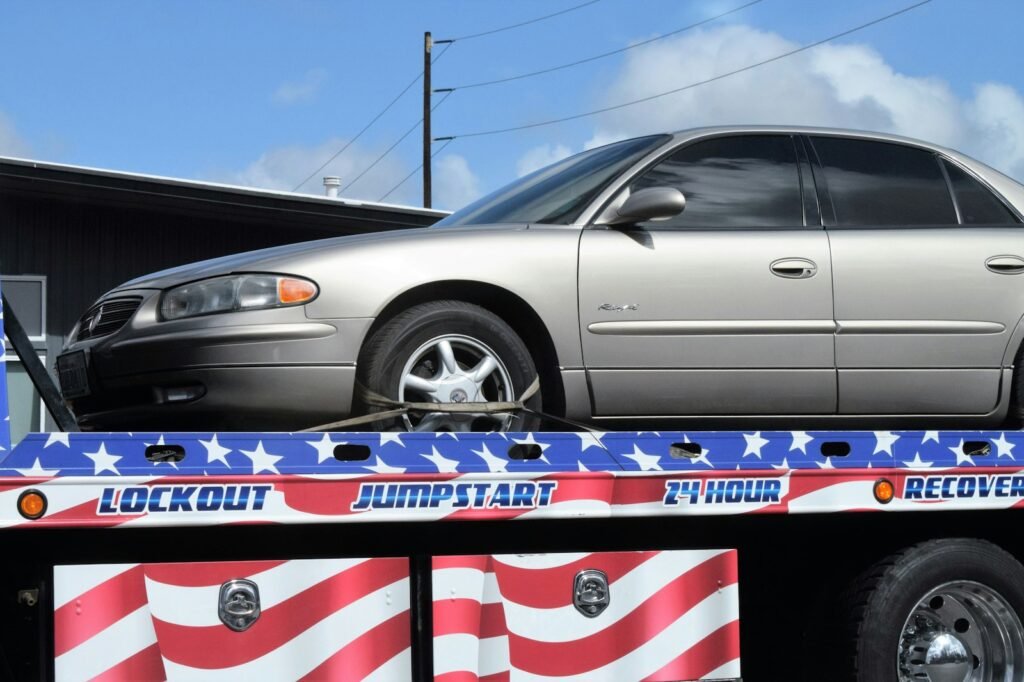
A good operator looks at the damage before picking the equipment. Here’s how it usually breaks down:
- Car or SUV, wheel or suspension damage: flatbed towing keeps all four wheels off the road.
- Car or SUV, cosmetic damage only, rolls and steers: standard light-duty towing may be all you need.
- Work van, box truck or pickup with a load: ask about medium-duty towing when you call, and give the truck’s size.
Leaking fluid, a hanging bumper or loose glass are all worth mentioning on the phone. They change how the car gets loaded and strapped.
When Accident Towing Means Recovery First
Some crashes end with the car off the pavement. Ditches, soft shoulders and grassy medians are common in Southeast Texas, and heavy rain makes the ground softer. A car in a ditch can’t just be hooked and pulled. It may need to be winched back onto solid ground first, slowly and at the right angle, so the frame and suspension aren’t damaged more.
Accident towing and recovery, and recovery from ditches after storms, are both services we list. If your car is stuck, don’t try to drive it out and don’t let a passerby yank it with a strap. Tell the dispatcher it’s off the road, and how far.
What to Tell the Dispatcher After a Crash
Give the location, whether anyone is hurt, whether police are there, and what the damage looks like. Then say if the car rolls, if it’s in a ditch, and where it should go. Those details decide which truck and gear get sent. A clear first call saves you a second one.
Use this short script. It builds on our general tips on how to call a tow truck.
- Where: road name, direction of travel, nearest exit or cross street. “I-10 eastbound, past the exit for…” beats “on the highway.”
- Safety: “No one is hurt” or “EMS is here.” “Police are on scene and said I can call my own tow.”
- Vehicle: year, make, model, and if it’s AWD, 4WD or electric.
- Damage: which corner, does it roll, does the steering turn, is anything leaking, did airbags go off.
- Position: on the shoulder, in a lane, in a median, or in a ditch.
- Destination: the body shop’s name and address, your home, or “I need to check with my insurer first.”
- Keys and callback: do you have the keys, and a good number to reach you.
When the truck arrives, the steps look a lot like any pickup. Our post on what happens during a tow truck pickup walks through them.
Ready with those details? Our dispatcher is a phone call away at (409) 790-1677.
Insurance Tow After an Accident: What to Ask Your Insurer
Every policy is different, so ask your insurer, not the tow driver, what’s covered. Good questions: Does my policy cover towing after a crash? Where do you want the car taken? Do I need to use a certain shop? Is there a limit on storage? If you can, get your claim number before the car leaves the scene.
The crash report may matter to your claim too. TxDOT’s crash reports page covers the basics:
- The Texas Peace Officer’s Crash Report is called the CR-3.
- Under Transportation Code §550.062, an officer who investigates a crash with injury, death, or apparent property damage of $1,000 or more to any one person must send a written report to TxDOT within 10 days.
- You can buy a copy online. TxDOT lists $6 for a regular copy and $8 for a certified copy.
- TxDOT no longer keeps Driver’s Crash Reports (CR-2). If police didn’t investigate, keep your own copy of any report you fill out.
Keep your tow receipt with your photos and the other driver’s details. Your insurer will tell you what else they need.
Where Does Your Car Go After an Accident Tow?
That depends on who started the tow and what your insurer wants. In a tow you called, you pick: a body shop, your home or a dealer. A nonconsent tow usually goes to a vehicle storage facility. TDLR says the owner and operator can agree to take it somewhere else instead, without the owner signing the tow ticket.
If the car isn’t worth fixing and it’s yours to sell, you have another option. Ask about cash for junk cars in Beaumont, and check with your insurer first if a claim is open.
Frequently Asked Questions
Can I sign a form at the crash scene to make it a consent tow?
No. The Texas Department of Licensing and Regulation says that when a tow at an accident scene is nonconsent, signing the tow ticket does not change it. The owner may only sign documents that authorize tow-related charges, not repairs. If an officer started the tow, it stays a nonconsent tow.
Do I have to call the police after a minor crash in Texas?
TxDOT says to call police when someone is hurt or killed, the vehicles can’t be moved, a driver may be drunk, a driver has no insurance, or a driver leaves the scene. If no one is hurt and the cars can be driven, Texas law says to move them out of traffic.
How do I get a copy of my Texas crash report?
If police investigated, you can buy the Texas Peace Officer’s Crash Report (CR-3) through TxDOT’s online Crash Report Online Purchase System. TxDOT lists the price as $6 for a regular copy and $8 for a certified copy, plus small processing fees. The report is sent to you by email after purchase.
After a police-ordered tow, can my car go to my shop instead of a storage lot?
It may be possible. TDLR’s tow ticket guidance says the owner and the tow operator only need to agree that the vehicle should go somewhere other than the vehicle storage facility. The owner does not have to sign the tow ticket for that. Ask the operator at the scene, and follow the officer’s instructions.
What can I do if I think a nonconsent tow charge was wrong?
You can request a tow hearing with a Justice of the Peace court. TDLR says the request must be filed within 14 days, not counting weekends and national holidays. You can also file a complaint with TDLR online. TDLR says a complaint is not a substitute for a hearing, but you may do both.
A crash is not a breakdown, and it helps to know the difference before the truck shows up. Get safe, follow the officer, ask your insurer the right questions, and call a tow you trust when the choice is yours.
Need accident towing now? Call Hawk Towing & Auto at (409) 790-1677. We’re open 24 hours, 7 days a week.
About Hawk Towing & Auto
Hawk Towing & Auto is a towing and roadside assistance company based in Beaumont, Texas. We tow cars, SUVs and motorcycles with light-duty, medium-duty and flatbed equipment. We also handle jump starts, flat tires and lockouts, and we buy junk cars. Our work covers Jefferson, Hardin and Orange Counties, and you can reach us 24 hours a day, 7 days a week.
Read more about Hawk Towing & Auto or see our full list of towing and roadside services.
Hawk Towing & Auto · 3140 Blanchette St, Beaumont, TX 77701 · (409) 790-1677